
The best advice I can give you is to get to know your vehicle before you get stuck. Imagine this: you’re driving along, enjoying the trip, when you notice the battery light glaring at you. Not good. Without power being restored to the battery, the engine will die in about 80 km or roughly 90 minutes because there’s no ignition, and your computer will shut down. You pull over and open the bonnet.
First option:
The fan belt has snapped. This is why you carry a spare. Let things cool a bit while you get the replacement belt and tools. Slack off the tensioners to fit the new belt and check for any damage or sharp edges on pulleys. If you find any, use sandpaper to smooth them out.
The workshop manual will help route the fan belt and advise on the correct tension. If you start the engine and the belt screeches, the tension is too low. Tighten the belt more, but don’t over-tighten it. For squeaky noises from a new belt, check that it’s not too tight. If it isn’t, apply a candle to the underside of the belt while the engine is running. The wax will lubricate the rubber without damaging it. Be careful of your fingers and the fan blades. That was the easy option.
Second option:
Second option: If the belt is okay, and the alternator turns with the motor. Now things get interesting. First, check the electrical connections and ensure there are no burnt wires or terminals. Second, check that you have 12V on the alternator because an alternator needs power to make power. Third, as a last resort, the problem might be worn-out brushes or a faulty voltage regulator (though this is unlikely).
Brush wear can be diagnosed by the charge light coming on dimly for a while and going off when revving the motor. Unfortunately, the only way to confirm your suspicion is to remove the alternator and open the unit. On Bosch alternators, you can remove the voltage regulator and brushes as a unit without removing the alternator, but the Mitsu ones I’ve seen need to be stripped. Once again, the manual comes in handy. Disconnect the battery before you start working.


The horrible moment has arrived. You have opened the alternator and found the brushes worn down and your toolbox is not the local Midas that is 300km away. If you don’t have a spare set of brushes, and you’re stuck.
Not so, the bush mechanics on page dirty advises:- Grab the first torch with normal batteries in and take one of the batteries out. Note It must be a normal and NOT a rechargeable battery. Normal batteries are zinc-carbon units and the carbon is exactly what we need. Use a side cutter to remove the outer cover of the battery. Do not worry as there is no battery acid or messy stuff inside and we did not go deep enough to get to the paste.
Looking at the photo you will see that it has a metal outer cover and then a plastic inner cover followed by a cardboard housing. In the center, there is a carbon rod that makes up the positive of the battery. This is what we need and it just slides out with a bit of gentle persuasion. Cut to length and sand down to the correct shape and voila you have a new brush.
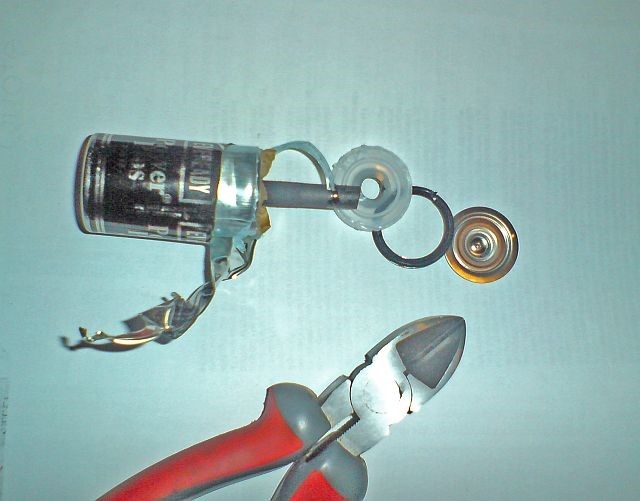
Cut off the old brush, keeping as much of the wire securing it to the unit as possible. Wedge this under the spring, insert the new brush into the holder, and reassemble the alternator. On Mitsu alternators, you’ll find a small hole in the back of the unit. Insert a short piece of stiff wire to hold the brushes away from the slip rings to aid with reassembly.
This carbon rod can be used for any kind of brush. Although it won’t last for 100,000 km, it will get you out of trouble. Handle it with care as it is fairly brittle, but it shapes well on just about any rough surface, such as stones, concrete fence poles, or even rusted steel.
Trick #2
You opened the bonnet and found one of the wires burnt off or a connector burnt. Time to get out the solder and either, bypass the connector or solder the terminal back onto the wire.
Wires burn because of loose connections carrying a lot of current and then arcing, I have never found a wire that has burnt off in the middle of the run, it is always at a connector or termination. Clean the terminal using sandpaper and cut back the burnt copper to healthy wire. The secret to a good solder joint is clean surfaces and enough heat. No soldering iron? No problem. Take your solder and pinch it flat using your pliers then wrap it around the joint.
Use a normal Bic lighter to heat everything. Heat until the solder melts, saturating the wire and joining it to the terminal. Let it cool and then tape it. The joint should be shiny, indicating a good connection. If it appears dull, it is likely a dry joint, where the solder did not adhere to the base properly, causing a bad connection that will fail again.
