
Just the word “Toothless Wonder” strikes fear and conjures images of greasy-haired, raggedly dressed individuals with oily rags in their back pockets. These figures loom over your pride and joy when you’ve broken down somewhere between hell and the tall grass.
If it wears a skirt or has four wheels, trouble and costs are inevitable. Weird things happen to good people, and if you’re not prepared, Toothless Wonder might be your best bet for reaching civilization. With a bit of knowledge and a lot of ingenuity, you can handle a sticky situation with minimal stress. As a bonus, your spouse might think you’re the proverbial knight in shining armor. Here’s a key point: bush mechanics differ from backyard mechanics. Backyard mechanics are ordinary parts fitters working from home, while bush mechanics use what’s at hand. The difference lies in ingenuity.
Ingenuity and determination alone won’t suffice; you’ll need some tools. The cheapest rubbish is better than none, but I recommend a decent set of tools. They don’t need to be Snap-on quality, but the pressed steel tools found in fancy plastic boxes with 101 bits won’t cut it. These tools are designed for laypeople and end up tucked away in cupboards, never used.
First, get a set of ring spanners from 8 to 19mm. These have a ring on one side and an open end on the other. Next, obtain a set of screwdrivers with flat and star points. Add a sturdy pair of pliers and a sharp side cutter, and you’re halfway there.

The tools mentioned are the bare minimum I’d recommend. For better organization, I use a canvas roll to keep them in my Pajero. Tip: Use your wife’s sewing machine to create a canvas or fabric roll-up caddy for the tools. This solution not only keeps everything together but also prevents rattling and helps you spot any missing tools after working.
To expand your basic toolset, you should definitely add a good shifting spanner and gas pliers. Skimping on these tools can lead to more problems than they solve. Specifically, cheaper units often fail to grip bolts properly, resulting in slipping and rounding off nuts or bolts. As a consequence, this can cause bruised knuckles and blood loss from these slips.
Moreover, another essential tool is a decent wheel spanner. You don’t want the cheap one that came with the vehicle to break, leaving you with a flat tire while the spare remains on its bracket. Instead, I use an extendable spanner that also functions as a ½” drive power bar. Tip: Invest in a 24mm socket for removing your tow bar during off-road trips. I discovered a handy set of box spanners at Midas, which are perfect for tight access. Additionally, Allen keys are useful and take up minimal space. Finally, a pair of long-nose pliers and a couple of vise grips should round out your toolset.
For example, when dealing with smaller spanner sizes, carry doubles. Often, you need two spanners of the same size to effectively loosen a bolt and nut.
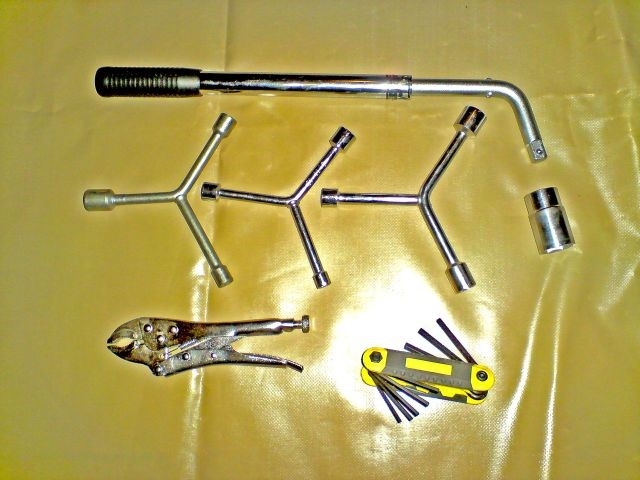
That should take care of the basic essential tools and with a few nice to-haves and essential spares you are on your way to becoming a self-sufficient bush mechanic.
Spares, Bits & Pieces
As with the tools, the quantity of spares you carry depends on you and your vehicle. For instance, a series Landy requires more spares than a Pajero. I’m going to list what I consider essential. However, be cautious: the risk with spares is that you might end up needing a truck just to transport them all.
Starting from the front: Spare lamps for indicator, headlights, and tail lights
- If you have spots a spare for them as well.
- Full set of fan belts. We all know the myth of nylon stockings. It does not work it is a myth.
- Radiator hoses (both)
- Spare thermostat
- Spark plugs
- Spare rotor and dizzy cap and the longest ht lead spare.
- Oil and fuel filter as well as 1m fuel line & clamps.
- Fuses.
Other bits & bobs
- Workshop manual for your vehicle
- Oil for engine, gearbox & diff as well as power steering
- Q20 or similar
- Insulation tape (good quality e.g.. Nitto)
- Some electrical wire & resin core solder (I carry some plumbing solder and a bit of flux as well as it has very good capillary action and seems to melt at a lower temperature, flux = corrosive)
- Cable ties and binding wire (non-insulated hard steel)
- Selection of bolts and nuts & bolts 6 – 10mm. Washers & split pins.
- A few pairs of surgical gloves (it is handy to throw away the dirt after changing a tyre)
- Tyre repair kit
- Silicone gasket maker
- Pratley Putty and epoxy
- Some metal sandpaper 80 & 600 grit.
- A piece of waterproof tarpaulin about 2m X 2m to work on.
That should be enough to cover most vehicle emergencies.